
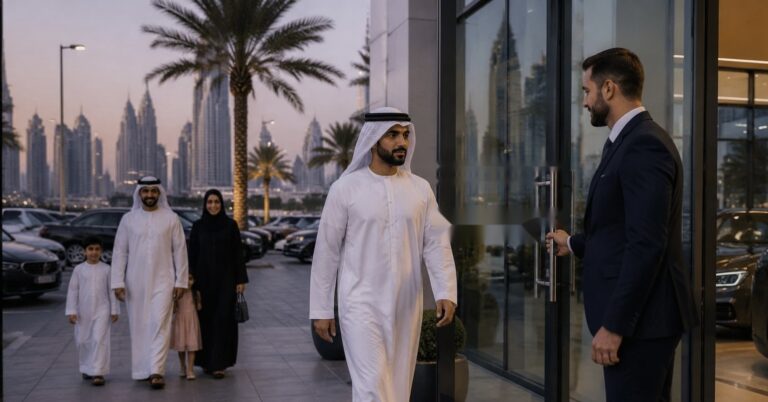
There is a comforting myth in the MENA Automotive industry. It goes something like this: our customers are loyal, our service bays are busy, and the buyers who walked the showroom three years ago will be back when it is time to replace the car. The data tells a different story, and Dealer Principals across the region need to hear it.
The MENA Automotive customer is among the most willing to switch brands of any major customer cohort in the world. Not because they are fickle, but because the market has trained them to be. Decades of intense brand proliferation, the rapid rise of new entrants, fast vehicle turnover cycles, and a generation of first-time buyers who feel no inherited loyalty to anyone, all of this has created a structural reality the industry is slow to confront. The customer you sold to in 2023 is not your customer in 2026 unless you have actively earned the right to remain so.
This is not a soft observation. It is the central commercial issue for every Dealer/Importer operating in the region today.
The MENA Reality
The conditions shaping customer behaviour in this region are distinct, and they need to be understood on their own terms.
Industry estimates now place new-entrant brand share in the GCC at close to one-fifth of total registrations, having moved from negligible to materially significant in under five years. In the UAE, those new entrants accounted for the majority of electric vehicle sales last year, and their model count has grown faster than any other category in the showroom. Buyer trust in these brands across Saudi Arabia and the UAE is reported to sit above seventy per cent. Forecasts now suggest that by 2030, new entrants could hold more than a third of the MENA market.
What does this mean for the incumbent Dealer/Importer? It means that the gravitational pull keeping a customer with your franchise is weaker than it has ever been. Vehicle exchange cycles in the GCC run as short as two to three years. The buyer is younger, more digitally fluent, and more open to switching than any previous generation of MENA Automotive customer. Social media and influencer reviews now outpace traditional research channels in the purchase journey. Roughly twenty-eight per cent of MENA buyers cite price and promotional offers as the single most important purchase factor, which means every retention conversation must also be a value conversation.
The point is not that MENA customers are less loyal. The point is that loyalty in MENA has to be manufactured, not inherited. The Dealers/Importers who understand that are pulling ahead. The ones who do not risk losing the most profitable customers in their database without realising it.
Where The Money Actually Lives
Market conditions in the region are shifting in ways that can quickly turn against operators who are not paying attention. Where used car inventory is expanding, days-in-stock can begin to lengthen and pricing pressure can intensify. In conditions like these, the cost of acquiring a new buyer tends to climb, and the customer already in your database becomes the most undervalued asset on your balance sheet.
Aftersales generates the majority of a typical dealership’s gross profit while representing a minority of its revenue. The customer who services with you is significantly more likely to buy their next vehicle from you. Once they stop coming through the service drive, the next purchase is almost certainly gone too. The aftersales bay is not a cost centre. It is the single most important sales pipeline in the building, and in MENA conditions, it is also the front line of the loyalty war.
Five Strategic Shifts for 2026
After running mystery shopping and aftersales reviews across the region for years, the same five opportunities come up time and again. These are the areas where the operators pulling ahead are quietly building their advantage.
One. From transactional to relational thinking. Most dealerships are still structured around the moment of sale. Loyalty, however, is built into everything that happens after delivery. The thirty, sixty, and ninety-day check-ins, the first-service handover, the proactive call before the warranty’s first anniversary, these are the touchpoints that turn a buyer into an advocate. Embedding them as a systematic process, rather than relying on individual initiative, is one of the highest-return investments a Dealer/Importer can make.
Two. Make the data work. Every Dealer/Importer in the region sits on a CRM and a DMS containing years of customer history, service intervals, model preferences, household profiles, and replacement cycles. The dealerships that treat this data as a strategic asset, rather than as back-office administration, are pulling ahead. Flagging when a customer is statistically due to replace their vehicle, recovering those who have missed two service intervals, tailoring offers to the customer’s actual ownership profile, this is where retention is engineered. A customer who feels known is a customer who stays.
Three. Build aftersales into a retention engine. Showroom standards in this region can be genuinely world-class, and there is a significant opportunity to bring the aftersales experience consistently up to the same level. Reducing variability in waiting times, strengthening service advisor capability, ensuring transparent pricing communication, and tightening the follow-up loop after each visit, all of these directly protect the next sale. The service lane is where the next vehicle purchase is either secured or quietly lost.
Four. Introduce structured loyalty programmes. Well-designed loyalty programmes remain underdeveloped across the MENA Automotive landscape, which makes this one of the clearest commercial opportunities in the region. A discount-led programme trains customers to wait for promotions. A relationship-led programme creates habitual engagement during the long gap between vehicle purchases. Points on service, priority booking, early access to launch events, referral rewards, partner benefits across lifestyle categories, none of this is expensive, and all of it is available to operators who choose to act.
Five. Measure what actually drives loyalty. CSI and NPS are widely tracked across the region, but the dealerships pulling ahead are the ones using them as operational inputs rather than compliance numbers. Moving beyond headline satisfaction metrics into Customer Effort Score, long-term NPS trend lines, service return rates, and conquest-versus-retention ratios in monthly KPI reviews gives leadership a much clearer line of sight. Independent mystery shopping then adds the layer internal data cannot reach, surfacing the gap between the experience the team believes they are delivering and the experience the customer actually receives. That gap is where the highest-impact gains usually sit.
The Mindset Shift
Beneath the strategies and the metrics, there is a more fundamental shift required. Customer loyalty cannot be delegated to a CRM system, a marketing campaign, or a one-off training programme. It must be embedded in how the receptionist greets a returning customer, how the service advisor explains a repair, and how quickly a sales manager follows up after delivery. Every customer interaction in a dealership is either building loyalty or eroding it. There is no neutral ground, and in the MENA market of 2026, the operators who treat every touchpoint as a loyalty moment are the ones who will lead their markets through the rest of the decade.
Where to Start
For most Dealers/Importers, the practical question is where to begin. Start with an honest assessment of current retention rates, not what is estimated, but what the data actually shows. Benchmark aftersales return rate, repeat purchase rate, and CSI and NPS trends across both sales and service. Identify the highest-impact gaps and build a sequenced plan to close them. The market is more competitive than it has ever been, and it rewards those who invest in the fundamentals: consistent execution, genuine customer relationships, and a relentless focus on delivering what was promised.
The customers you have today are your most valuable asset. The question is whether your business is structured to keep them.
About AMENA Auto
AMENA Auto is the independent Automotive body for the MENA region, supporting OEMs and Dealers/Importers across sales, aftersales, parts, CSI, NPS, and customer experience. Through strategic Consultancy, expert-led Training, in-depth Mystery Shopping programmes, and rigorous executive Assessment, we help organisations across the region move from intention to measurable impact. Whether the priority is strengthening aftersales retention, improving showroom conversion, or building a culture where every customer interaction strengthens loyalty, we work alongside leadership teams to transform performance and protect long-term profitability.
To find out how AMENA Auto can help your business find more, win more, and keep more clients, visit www.amenaauto.com or speak to our team.
Contact Us Today! At office@amenaauto.com
Follow us @ Linkedin | Youtube| Instagram | Facebook
We express our sincere gratitude to all the veterans and experienced professionals in the automotive industry for their valuable input and advice when we write our articles. We take pride in our commitment to embracing technology, including AI, to enhance the quality of our articles.